
Appalachian Schoolhouse Christmas | A One-Room Holiday Memory
Chapter 2 –
Appalachian Schoolhouse Christmas
If an Appalachian schoolhouse Christmas had a heartbeat, it thumped loudest inside that little coal camp schoolhouse. The walls were thin, the floorboards creaked, and the stove rattled every time someone sneezed — but in December, it felt like the warmest place in the world.
Miss Hattie Lou Morgan (we all just called her Miss Hattie) always said, “Children, this classroom is your second home,” and she meant it. She treated each of us like we were kin. Maybe that’s why the Christmas season seemed to glow brighter within those four wooden walls.
The first week of December, Miss Hattie announced something no teacher in our coal camp ever had before.
“Children,” she said, hands folded like she was holding a secret, “we’re going up the ridge today to fetch our Christmas tree.”
You could’ve heard a pine needle drop. A real tree — one with a trunk, branches, and room for every ornament our hands could dream up.
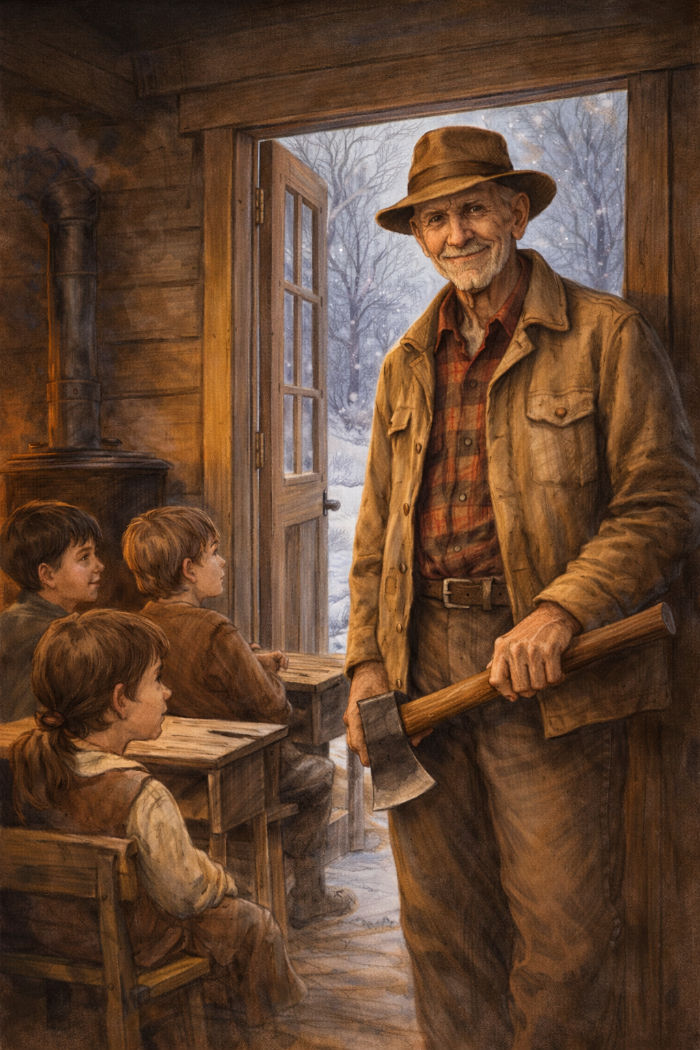
Papaw Henry appeared in the doorway just then, coat already on, axe in hand. “Reckon you’ll be needin’ help cuttin’ it,” he said with a grin.
We set off up the ridge in a crooked little line, our boots crunching frost, breath puffing into the cold air. Miss Hattie kept us close, pointing out rabbit tracks and icicles hanging from low branches. Papaw Henry hummed the whole way — something between a hymn and a whistle — the tune warming the air around us.
When we reached the ridge, he paused beneath a cedar standing straight as a church steeple. “This one’s got good bones,” he said. Miss Hattie nodded, the light catching in her eyes.
We stood back while Papaw Henry steadied the trunk, swung the axe, and let the fresh scent of cedar spill into the cold morning. The tree landed soft as a feather.
“Children,” Miss Hattie said, brushing snow from its branches, “this is the beginning of Christmas at our school.”
We nodded, breathless — because nothing about that moment felt crooked or humble. It felt like magic.
Miss Hattie handed out scraps of colored paper, paste she mixed herself, bits of yarn, buttons, and whatever else she’d collected over the year. Some came from her own pockets. Some came from Mamaw Elsie at the store. And some, we later realized, were carved by Papaw Henry in that secret little shed.
Day by day, our ornaments took shape:
Wobbly stars covered in too much glitter.
Chains of paper loops long enough to wrap a whole room.
Snowflakes so lopsided they looked like they’d melted and refrozen.
Wooden circles we painted with trees, sheep, and snow.

Every child held their ornament like it was priceless. And maybe it was — not because of how it looked, but because it meant we had something to take home. Something to hang on a tree that might have been bare otherwise.
Miss Hattie knew this. You could see it in her face when she said, “Take your time, children. These little things matter.”
Some days, she practiced carols with us for the parade float. Other days, she helped the older kids rehearse lines for the church pageant. But no matter what the lesson plan said, Christmas always found its way in.
She even taught us a song she said her own mother sang in the mountains:
“Star of hope and star of light, Shine above our hills tonight.”
We sang it softly, the way mountain folks do when the words feel sacred.

On the last day of school before break, Miss Hattie stood behind her desk and called us up one by one. She handed each of us a folded paper pouch with our ornament tucked inside, a peppermint stick peeking out the top. Most teachers would’ve just sent them home, but she placed them gently in our hands like she was giving out fragile treasures.
“Make your home bright,” she whispered to every child.
And we did. Even if all we had was a crooked cedar branch, a string of popcorn, and that one ornament we made with our own little hands.
In a coal camp, that was enough to make Christmas feel real.


Comments